
Why Is My Split AC Not Cooling? 10 Causes and What to Check in Jeddah
Table of Contents
If your split AC is running but not cooling, the most common reasons include blocked airflow, low refrigerant due to a leak, a dirty coil, an issue with the outdoor unit, or a faulty part such as a capacitor or thermostat sensor. You can check some of these yourself in just a few minutes. For anything related to refrigerant, wiring, or internal electrical parts, it is safest to call a licensed AC technician.
The symptoms you notice can help narrow down the problem before you even open the unit. For example, if air is moving but still warm, if airflow is weak, if you see ice on the pipe, if the outdoor unit will not start, or if cooling drops off in the afternoon, each points to a different cause. Checking these issues step by step can save you time and help you avoid unnecessary repairs.
Match Your Symptom to the Likely Cause
| What you notice | Likely cause | Safe check | Professional diagnosis needed if |
| Strong airflow, but air feels warm | Refrigerant leak, dirty coil, or compressor issue | Confirm mode is Cool, check filter | Warm air continues after basic checks |
| Weak or reduced airflow | Dirty filter or dirty evaporator coil | Clean the filter | Airflow stays weak after cleaning |
| Ice on the indoor coil or copper pipe | Restricted airflow or low refrigerant | Turn off cooling, let it thaw fully | Ice returns after thawing and filter cleaning |
| Outdoor unit not running at all | Tripped breaker, electrical fault, or capacitor issue | Check breaker and power supply only | Breaker is fine, and unit still will not start |
| Water leaking indoors | Blocked condensate drain or frozen coil | Check drain line and filter | Leak continues, or source is unclear |
| Cools well at night, weak in the afternoon | Existing fault exposed by higher heat load | None safe beyond a visual check | Almost always, since the underlying cause needs testing |
This guide is just a starting point, not a full diagnosis. Use it to find which section below matches your situation.
1. Dirty or Clogged Air Filter
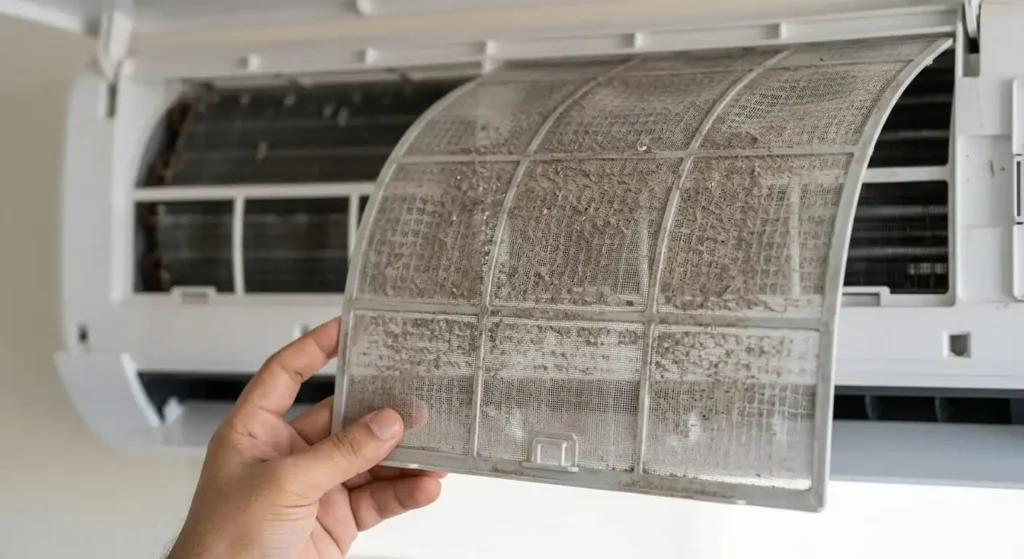
A blocked filter is one of the most common reasons a split AC does not cool well, and it is also the easiest thing to check yourself. The filter allows air to flow over the evaporator coil, which removes heat from the room. When the filter gets clogged with dust, airflow drops, the coil cannot remove heat as well, and cooling decreases even though the compressor keeps running.
Because Jeddah is dusty and humid, filters can build up dirt in just a few weeks during heavy summer use. Turn off the unit, remove the filter, rinse it gently with lukewarm water, let it dry completely, and put it back in. Most homeowners can do this safely, and it is worth checking before anything else. If the filter is heavily clogged or the cooling remains weak after cleaning it, professional AC cleaning in Al Bawadi can help clean the parts you cannot safely reach yourself.
2. Low Refrigerant or a Refrigerant Leak
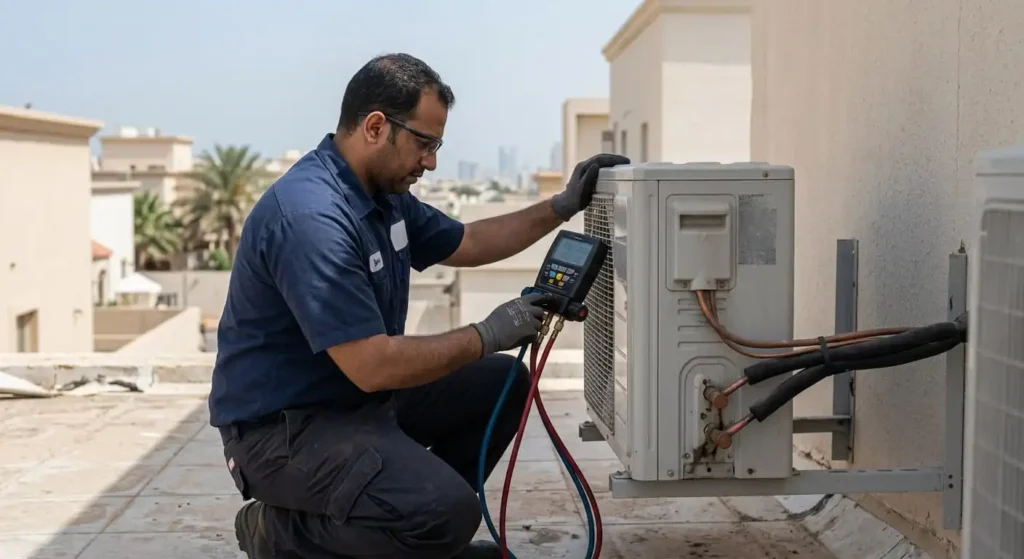
Refrigerant is the fluid that moves in a closed loop, taking heat from inside and releasing it outside. In a properly installed system, refrigerant should not run low over time. If the level is low, it usually means there is a leak somewhere, not just that it needs to be topped up.
Watch for signs such as a hissing sound near a pipe or joint, ice forming where it shouldn’t, a compressor that runs constantly but never cools the room, or an outdoor unit that feels warm while the indoor unit also stays warm. Do not try to test or fix these issues yourself. Finding leaks and refilling refrigerant needs special tools and training, so a technician should handle this.
3. Dirty Evaporator Coil
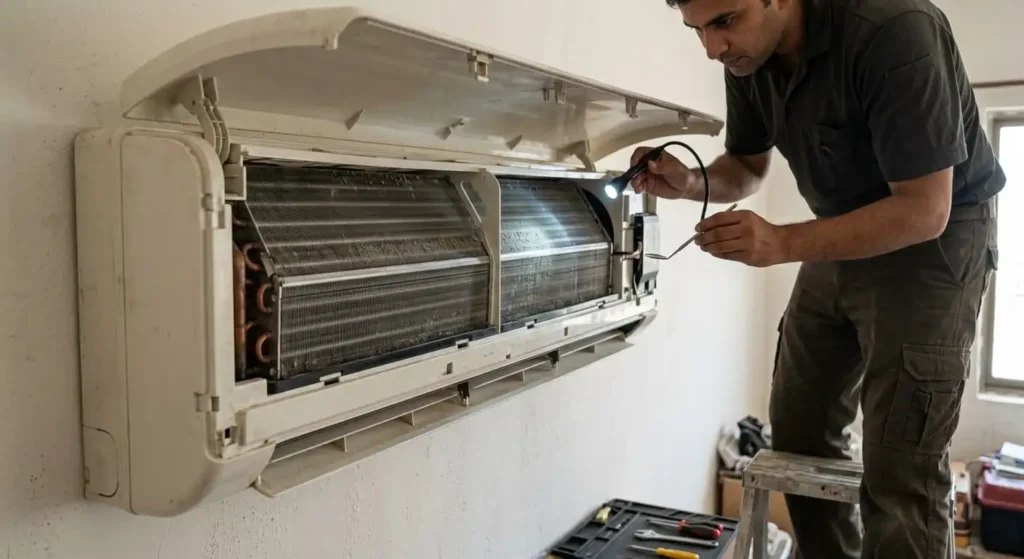
The evaporator coil inside the indoor unit is where heat is removed from the air as refrigerant flows through it. If dust covers the coil, it cannot transfer heat as well, so the system may run longer but cool less effectively.
A dirty coil often causes weaker airflow or a musty smell. You can sometimes wipe away surface dust on the edges after turning off the unit, but cleaning between the fins is best left to a technician. The fins bend easily, and cleaning them the wrong way can worsen airflow.
4. Dirty or Obstructed Outdoor Condenser
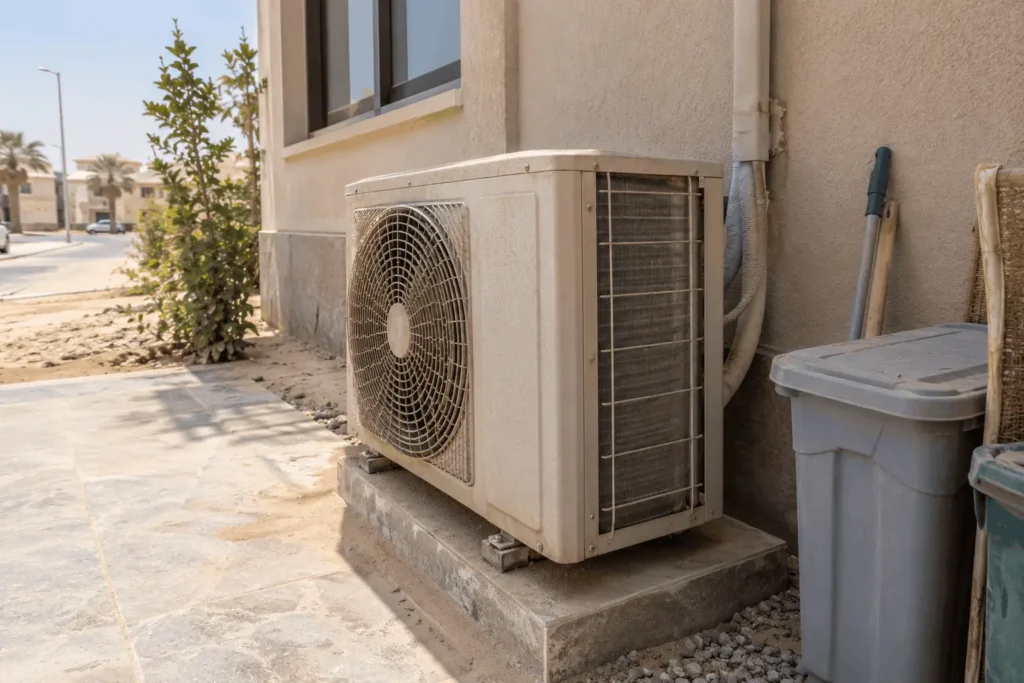
The outdoor unit dissipates the heat removed from inside your home. If the condenser fins are covered in dust or sand, or if the unit is surrounded by walls, plants, or stored items, heat cannot escape well. This lowers cooling performance for the whole system, not just outside.
As a homeowner, keep the area around the outdoor unit clear by removing leaves, sand, and debris, and make sure nothing blocks the unit. Leave cleaning the fins or using water near electrical parts to a technician, as doing so incorrectly can damage the fins or pose a safety risk. This problem is often missed because the unit may look fine from a distance.
5. Frozen Evaporator Coil or Copper Pipe
Ice on the indoor coil or refrigerant line is a sign of another problem, not a cause by itself. It usually happens when airflow is blocked, often by a dirty filter or coil, or when refrigerant is low. In both cases, the coil gets too cold, and moisture freezes on it instead of draining away.
If you see ice, turn off the unit completely and let it thaw out, which may take several hours. Do not turn the cooling back on until all the ice is gone. If ice comes back after you have cleaned the filter, the problem is likely something you cannot fix yourself. Running the system while it is frozen can also damage the compressor.
6. Outdoor Unit Not Operating Properly
Sometimes the indoor unit blows air as usual, but the outdoor unit doesn’t turn on or runs strangely. Because the compressor and condenser fan are outside, if the outdoor unit isn’t working, the system cannot cool the room. Possible reasons include a tripped breaker, a control problem, wiring issues, or a broken part inside. The only safe thing to check yourself is whether the breaker has tripped and if the unit has power. Do not try to open or fix anything else, as it can be dangerous and easily damaged without proper training.
7. Faulty Capacitor
The capacitor gives the compressor and fan motor the boost they need to start. If the capacitor is weak or has failed, the outdoor unit may hum but not start, or it may start and stop repeatedly.
Capacitors are cheap to replace, but they can still hold an electrical charge even when the unit is unplugged. This makes them dangerous for anyone without electrical training. If you hear humming, clicking, or see a fan that will not spin, tell a technician about these symptoms instead of trying to test or replace the capacitor yourself.
8. Weak Fan Motor or Airflow Problem
A split AC has two fans: the indoor blower, which sends cool air into the room, and the outdoor fan, which helps remove heat. If either motor is wearing out or a fan is blocked, cooling will be weaker even if the refrigerant and coils are fine. Signs include a weaker breeze from the vents, strange noises from either unit, or an outdoor fan that spins slower than usual. A worn motor usually needs to be replaced, and it is best to have a professional determine which fan is causing the issue.
9. Thermostat, Sensor, or Control Problem
Sometimes the AC hardware is working, but the problem is with what the system thinks it should do. If the temperature sensor is not working right, the unit may think the room is already cool and turn off the compressor too soon. A problem with the control board can cause similar issues.
Before thinking it is a sensor problem, check the basics: make sure the mode is set to Cool, the set temperature is lower than the room temperature, and the remote batteries are fresh if the controls are acting up. If the unit still turns off too soon or fails to maintain the set temperature, have a technician check the sensor or control board.
10. Compressor or Cooling Capacity Problem
If the compressor fails, cooling will drop significantly or stop completely. However, people often assume the compressor is the problem too quickly. Often, what looks like a failed compressor is actually a more common issue, such as blocked airflow, a refrigerant leak, or an unresolved electrical problem.
A proper diagnosis rules out common issues before deciding the compressor has failed. It is also important to ensure the AC is the right size for the room, because a small unit will never cool a large space properly, no matter how well you maintain it.
Why does my AC cool at night but Not During the Day?
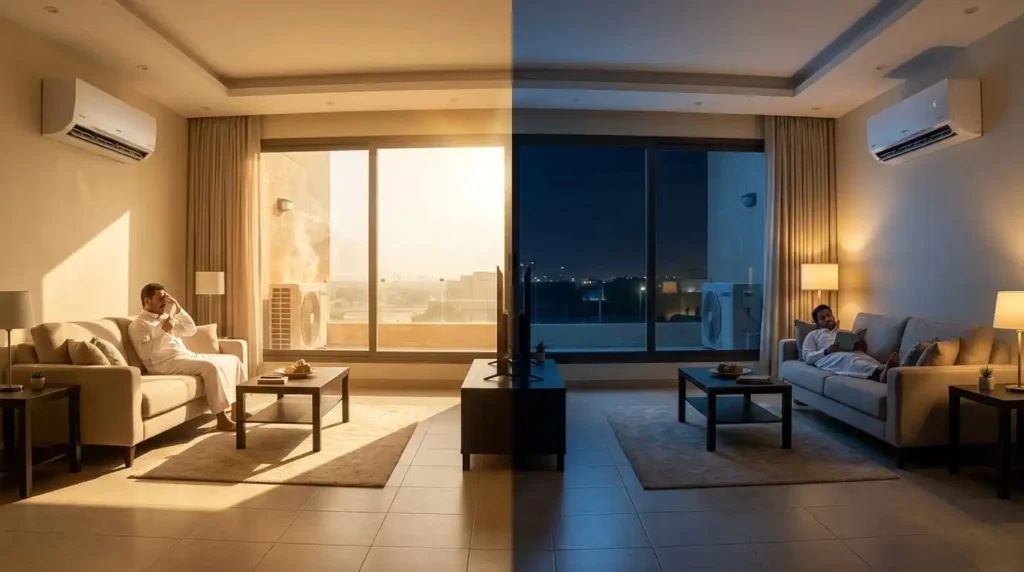
This is a common problem during Jeddah’s hottest months. It usually means an existing issue is getting worse, not that a new problem has started. When it is hotter during the day, the outdoor unit has to work harder to release heat. This can make a dirty condenser, low refrigerant, or an old capacitor cause more trouble in the afternoon, even if the problem was not obvious at night. For information on air conditioner energy efficiency requirements in Saudi Arabia, see the official SASO energy efficiency labels.
If your AC works worse only during the hottest part of the afternoon, take it as a sign that something needs to be checked, not just normal heat the system should handle.
What to Check Before Calling an AC Technician
You can safely do these basic checks yourself, and they only take a few minutes. They may solve a simple problem or help a technician identify the cause faster if the cooling does not improve.
• Confirm the mode is set to Cool, not Fan, Dry, or Auto
• Set the temperature clearly below the current room temperature
• Clean the filter if it looks dusty
• Check whether the airflow feels weaker than usual
• Look for ice on the indoor coil or copper pipe
• Confirm the outdoor unit has power and the breaker has not tripped
• Note any water leakage, unusual smells, or unfamiliar sounds
If your split AC is still running but not cooling, you can learn more about professional AC not cooling repair in Al Bawadi and what a technician checks before repairing the problem.
Does Low Refrigerant Mean You Need More AC Gas?
Split AC systems are sealed, so under normal operation, refrigerant does not need routine topping up. If a technician finds that the refrigerant level is low, the main goal should be finding and repairing the leak, not just adding more gas.
A proper repair involves locating and sealing the leak before recharging the system to its correct operating level. Recharging refrigerant without fixing the leak is only a temporary patch; gas will continue to escape, and your cooling problems will return within a few weeks or months. If a refrigerant problem is confirmed, see our AC gas refilling in Al Bawadi service for professional refrigerant checks and refilling.
Why Jeddah Conditions Can Make Cooling Problems Worse
Jeddah’s heat, humidity, and dust make many of these AC problems worse. Filters and coils get dirty faster, especially when it is windy or dry. Running the AC for long hours in summer puts extra strain on compressors, capacitors, and fan motors. Outdoor units in direct sun and coastal humidity also face more stress than in cooler places.
This does not mean these problems are unavoidable. It does mean you can avoid these problems. It just means that checking the filter often and keeping the outdoor unit clear of debris is even more important in Jeddah than in cooler places. Ignored problems also tend to show up sooner here. Remote settings and mode, basic airflow strength, visible ice, breaker status, and a general visual check of the indoor and outdoor units from a distance.
A technician should handle refrigerant level checks and leak checks, capacitor testing or replacement, wiring or electrical issues, compressor diagnosis, fan motor replacement, control board or sensor issues, and coil cleaning beyond the filter.
If you have completed all the homeowner checks and your AC is still not cooling, it is time to call a professional AC technician in Al Bawadi rather than trying to fix it without the right tools. Problems like refrigerant leaks or electrical faults usually become more expensive to fix the longer they go unaddressed.
If your split AC in Jeddah is still not cooling after these checks, Abdulhaadi Cooling technicians can visit your home, identify the root cause, and perform the necessary repair, cleaning, or gas leak detection to get it working again.
Frequently Asked Questions
Why is my split AC not cooling?
The most common causes are a dirty filter, a dirty coil, a blocked outdoor unit, a refrigerant leak, or an electrical fault such as a failing capacitor. Start with the filter and outdoor unit clearance, then have a professional check it if the problem persists.
Why is my split AC running but not cooling?
This combination usually points to restricted airflow, a refrigerant leak, or a compressor that is running but not completing the heat exchange properly. It is one of the clearest signs that you need a professional diagnosis, not a simple settings fix.
Why is my split AC blowing warm air?
Warm air from a running unit can mean the mode or temperature setting is incorrect, the coil is too dirty to absorb heat effectively, or the refrigerant level has dropped due to a leak. Checking the mode and setting is the fastest way to rule out the simplest cause first.
Can a dirty filter really cause weak cooling?
Yes. A blocked filter restricts airflow across the evaporator coil, reducing the system’s ability to remove heat from the room and eventually leading to ice buildup if left unaddressed.
How do I know if my AC needs refrigerant?
Signs include continuous running without reaching the set temperature, a hissing sound near the unit, ice where it doesn’t normally form, and reduced cooling that doesn’t improve after cleaning the filter. A technician can confirm this with a pressure check rather than guesswork.
Why is my split AC freezing instead of cooling?
Freezing occurs when airflow is restricted or refrigerant levels are low, both of which cause the evaporator coil to run colder than normal. Turn the unit off and let it thaw completely before running it again. Have a technician check the underlying cause so it doesn’t happen again.
Why does my AC cool well at night but not during the day?
Higher daytime heat puts extra load on the outdoor unit, which often exposes an existing issue, such as a partly dirty condenser or marginal refrigerant level, that was not as noticeable at cooler nighttime temperatures.
Should I just refill the gas if cooling has dropped?
Not without first finding out why the refrigerant is low. Since the system is sealed, low refrigerant almost always indicates a leak, and refilling without repairing it usually means the same problem will return quickly.
When should I call an AC technician for a cooling problem?
Call one once you have ruled out the filter, mode, and basic settings and the problem persists, or right away if you notice ice, unusual sounds, water leakage, or the outdoor unit not running at all.


